


What is the cost of pipe relining in Sydney?
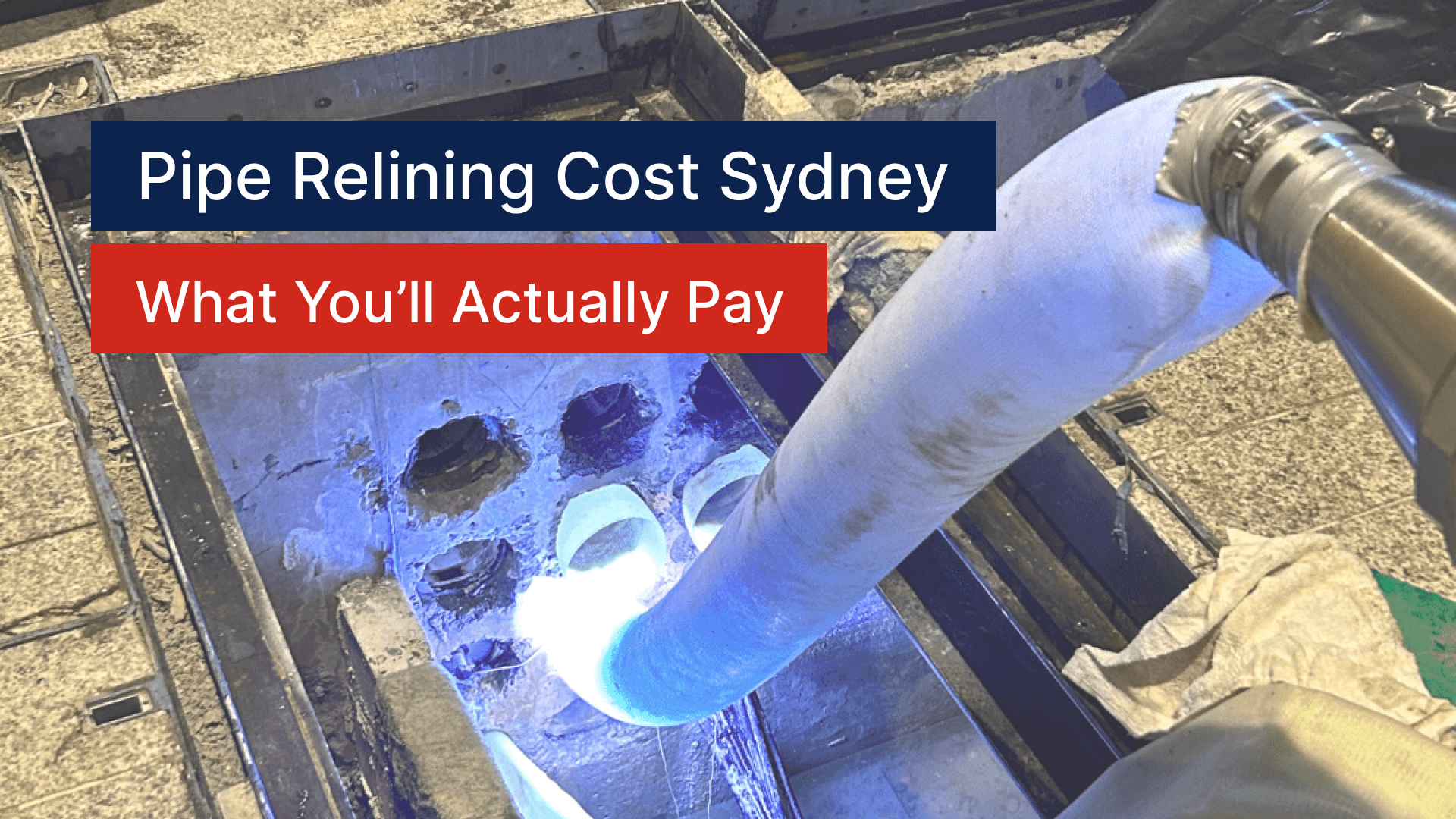
The usual cost for pipe relining in Sydney is between $400 and $1,200 per metre. The usual cost for relining is about $2,400, since this type of project involves pipe camera inspection, drain cleaning, the use of special equipment, resin preparation, and liner installation. Additional metres are generally priced according to the scope of works
The amount depends on the size of the pipe, access difficulties, the location of the repair and the extent of the damage. For residential sewer and stormwater projects, the typical cost per metre is in the range of $400 to $700 and in more complicated installations the cost is generally between $650 and $850 per metre.
Pipe Relining Per Metre
Sectional Patch Repairs
Patch relining is a procedure in which only a particular part of the pipe is repaired rather than the whole section of the pipe. If a CCTV drain camera inspection shows that just one part of the pipe is damaged while the rest of the pipe is in good condition, then patch relining should be carried out. It is the most effective way of dealing with damage since only the affected part of the pipe is repaired and not the entire pipe. The liner material is positioned directly onto the damaged pipe at the site of either a cracked joint or a root entry. The method is cheaper and offers a permanent solution to the problem.
When is it acceptable to use a patch? When the CCTV footage has confirmed that the pipe is structurally sound, capable of holding the liner material, and only one part of it shows signs of damage. In the case of an old pipe which has several joints that have failed, patch relining would turn out to be costly.
Full-Length Relines
If the camera shows damage over a long section or if more than one defect is present, a complete reline is generally the better option. A complete reline involves repairing the existing pipe between two access points, usually the part of the sewer pipe between the house and the property boundary, or between the boundary and an inspection manhole. This type of work is typical of most residential jobs in the inner west of Sydney.
The flexible liner is put in over the whole length of the pipe, thus creating a continuous new pipe within the existing one. For longer lengths, the effective rate per metre tends to decrease since the fixed setup cost is spread over a greater number of metres.
Junctions and Reinstatement
All the branches or junctions that the liner includes have to be reopened later in order that the side pipes may still function. Each junction that is cut increases the cost. When the liner is curing, the junction opening is covered by the structural liner; afterwards, a robotic cutter reopens it from inside the pipe while the liner is in place. The reopening job of the junctions is included as a standard thing in many quotations and is charged separately from the rate for the pure linear metre.
When a junction is damaged and requires its own liner, it is known as junction relining. Additional costs vary depending on the angle of the junction and the diameter of the pipe. In case of a property that has two or three junctions in the relined section, this is one of the most considerable extra charges over the basic rate per metre.
Typical Project from ~$2,400
Because the same basic equipment, labour and setup are needed for each job, even the smallest job begins at about $2,400. The examples below are realistic ones drawn from typical cases in the Inner West. However, all the quotes will be adjusted once the camera has determined the exact length, pipe size and number of junctions):
- A section of relining, consisting of 3 to 4 metres, laid along a rear terrace path, usually ends up near the lower end when cleaning and the patch have been considered.
- A sewer installation of medium size, measuring between 6 and 8 metres and having one or two junctions, is typical of the middle range when the cost on a per metre basis and the work involved at the junctions are taken into account.
- A run that is longer, ranging from 12 to 15 metres, along the driveway or the side access, involving a number of junctions and requiring a higher degree of pre-cleaning: the total cost will increase in this case, even though there will be no need to carry out excavation.
Example: a straightforward Inner West repair
Let's look at a situation involving a house in the Inner West which has an established garden and about 6 metres of cracked clay sewer pipes underneath it. The camera shows that the clay portion of the pipe is intact but the joints are broken, with roots entering through these cracks.
Where the pipe has an accessible section and involves no complicated junctions, it will fall within the typical scope of work carried out by home-based labourers. At a rate of $500 per metre, six metres would amount to $3,000.
Example: a longer repair beneath a finished surface
Consider a pipe that is 12 metres long and has been damaged so that it lies under a driveway and a concrete slab; the length of the pipe increases the quantity of liner material and resin that is required. Moreover, if there are a number of bends and branch connections, the procedure becomes more complicated.
At the cost of $650 per metre, 12 metres would cost you $7,800, excluding any other works that may have been done outside the agreed terms.
Example: difficult access and multiple junctions
A third property may have only 8 metres requiring repair, but the line could sit beneath retaining walls with several branch connections. It is shorter in terms of length when compared to the second case, although it would need more specialist preparations and connection points. This might increase the cost. This is precisely the reason why an accurate quotation should come only after a CCTV inspection, and not on the basis of the distance alone.
Pipe relining vs pipe replacement: compare the whole job
Cost
The cost of pipe relining is usually lower as it does not involve unnecessary excavation or major disruption. For traditional replacement, it is important to carry out excavation, remove the old pipe and restore all that is above it. This restoration can involve gardens, paving, driveways, flooring, retaining walls or other surfaces. Pipe relining causes minimal disruption, unlike the traditional excavation method and costs less.
Lifespan
A relined pipe is often stronger than new PVC pipes. It can last up to 50 years with proper care and if installed by professional experts. The lifespan of replaced pipes depends on the quality of the pipes.
Excavation and reinstatement
When using traditional methods, the ground above the pipe has to be dug. In places where a sewer pipe is situated underground in a garden, the replacement requires the removal of the plants as well as digging out the pipe and then reconstructing the ground which had been disturbed. With relining, the pipe is used as the conduit for the new pipe. When the pipe is appropriate and accessible, the job does not require digging up the ground over its entire path and ensures minimum disruption.
Time
A suitable residential relining job can often be completed in a few hours once the pipe has been inspected and prepared, although larger or more complicated jobs can take longer. Replacement involves excavation, removal, installation and restoration. The actual pipe installation is only one part of the job. The difference becomes particularly significant when reinstatement is substantial.
Long-term repair
Relining seeks to offer a long-term fix for a suitable damaged pipe through the creation of a new structural lining inside the existing pipe. The epoxy resin used in relining is highly resistant to corrosion. On the other hand, replacement involves the creation of a new pipe, thus providing a long-term fix. However, neither of the two methods can be used in all situations.
In case the pipe is completely collapsed, badly out of alignment, or cannot accept the liner, then replacement will be required. Liner requires a pipe that still has some structural integrity.
So when asking whether pipe relining is worth the money, the answer depends on the condition of the existing line and the cost and consequences of accessing it.
What's Free on Every Job
CCTV Inspection for Free: Every quote for pipe lining services offered by Sewer Surgeon comes with a free CCTV inspection of your drain. The inspection results in footage which will determine the nature of work required, verify if the pipe is a suitable candidate for the procedure and be the basis for a fixed-price quotation.
Price Quote is Fixed: The price of relining that is agreed upon during the inspection is the price shown on your bill. There will be no mid-project price changes and no additional costs for anything discovered by the camera after the project starts.
CCTV Verification After Cure: Once the liner is placed inside the pipe and cured, the camera returns to check whether the relining process was successful and all junctions are open. It is included in the cost.
Payment & Finance
For most homes, pipe relining involves a considerable expense, especially in cases where the minimum project cost of $2,400 is an unexpected one. Since it is a specialised type of repair, the cost can become high if several metres of pipe need to be treated or if access is difficult or there are multiple junctions.
Before you approve the work, ensure that you understand the total cost, what is covered, the payment schedule and any finance options that are available. In the case of standard residential plumbing jobs, most pipe relining companies follow a system in which payment is made upon completion: a quote is agreed upon before the work begins.
It is necessary to look over the relevant terms, fees and repayment conditions rather than simply comparing the providers on the basis of the advertised monthly figure. What is important is that the payment arrangement should be kept separate from the technical decision. You should first check whether the pipe relining method is suitable for the damaged pipes and then think about how the approved work will be paid for.
After the inspection, we will provide transparent and fixed-price quotes; the payment terms are settled beforehand. In the case of bigger jobs, we can look into 0% finance options so that the work can go ahead without having to make an immediate full payment. All the details are confirmed in writing together with the quote so that there are no surprises later on.
What causes a quote to rise?
Pipe diameter and size
The diameter of the pipe affects how much liner and resin is required; the greater the size of the pipe, the larger its internal surface area, and liner material and resin used will therefore be adjusted accordingly. This is the reason why two projects involving larger pipes cannot be compared.
Access points
Access is one of the practical factors that can have a major effect on installation. A straight line with an accessible inspection point is easier to work on than a pipe buried beneath a difficult section of a property. The number and position of access points, the distance to the damaged section and the layout of the property can all influence the work.
Pipe condition
Every underground pipe which is defective cannot withstand pipe relining, especially if it is an old earthenware or cast iron pipe. An evaluation of the pipe's condition is necessary. In some cases, the pipe may have collapsed so much that it would not be suitable for having a liner inserted.
Pre-clean condition
Before liner installation, the pipe needs to be clean. If tree roots, grease, scale or debris are blocking the line, those materials need to be removed first. Root cutting may be necessary where root intrusion is causing major obstruction.
For lining preparation, we use hydro jet drain cleaning Sydney. For established root problems blocking the drain, we offer tree root removal Sydney.
Pipe length
The cost of relining the pipe on a per-metre basis naturally goes up as the length of the section being lined increases. Yet the length shouldn't be the only factor taken into account. A long, straight and accessible pipe is in fact easier to line than a shorter pipe which has several bends and connections. Because of this, the final price should take into consideration the actual CCTV findings and the measured scope.
Junctions and bends
Any branch which is required to remain in operation can have extra work carried out. If there are several junctions, sharp bends or changes in pipe diameter, it may be necessary to carry out additional work or cutting after curing. This situation also arises when a liner has to go through a complicated part of the drainage system.
Pipe material
The preparation needed can vary depending on the type of pipe. It is common for older clay and earthenware pipes to be found in older properties in Sydney. Since cast iron, concrete and PVC pipes have different properties, it is necessary to check whether the existing pipe is suitable rather than assuming that one relining method will work for all types of material.
Ground conditions and obstructions
Damage due to ground movement may result in sections of the damaged drain no longer having their circular shape. Permits obtained from the council for any excavation necessary near public infrastructure lead to an increase both in the time and cost of jobs in which access at street level is required. These conditions are identified during the CCTV drain camera inspection and are specifically quoted before work begins.
How to compare pipe relining quotes
The rate per metre itself doesn't tell you much about your job; even if two quotations offer $550 per metre, they can still result in quite different invoices since what is included in each differs. When you are looking at quotations for pipe relining in Sydney, you should check the following points before you commit:
Does the rate on a per metre basis include the cost of the CCTV drain camera survey both before and after? Is the pre-clean jet blast covered? How many junction reinstatements are included and at what price for each? Is there a free inspection available if you decide not to have the service? Is the per metre rate a fixed fee or an estimate?
More questions to ask -
How many metres are quoted? - The quote must give an approximate/confirmed length of pipe instead of just the price per metre.
Is cleaning included? - Enquire about high-pressure cleaning and root removal that may be part of the service or an extra charge.
Are junctions included? - In case of branched pipe, clarify the price of junction reinstatement.
What if the pipe can’t be relined? - A proper assessment will reveal such technical difficulties beforehand.
What does the $2,400 minimum cover? - This point is especially relevant for short jobs. The minimum job cost is justified by the necessity of using the equipment for a relining task regardless of the number of metres to be repaired.
Finally, request the CCTV footage. It provides a visual confirmation of the damage and the outcome of the relining process.
Frequently asked questions
How much does pipe relining cost per metre?
Pipe lining usually runs from $400 to $1,200 per metre, while usual domestic applications for sewer lines and stormwater range from $400 to $700 per metre. More complicated projects normally go for about $650 to $850 per metre. In addition, there is also a minimum project charge of about $2,400, since every project involves inspection, cleaning, specialised equipment, and resin application.
Is relining cheaper than replacement once restoration is counted?
Yes, in most instances. The addition of costs involved in the excavation process and reinstatement of driveways, paths, garden areas, or concrete areas makes pipe relining the more economical choice when compared to traditional pipe replacement, especially if a liner can be accommodated within the existing host pipe.
Does insurance cover relining?
Coverage of your expenses is dependent upon the insurance plan, the source of the damage, and your claim conditions. Some insurance plans treat sudden insured damages differently from gradual damage, problems with maintenance, and even damage caused by tree roots. You can't assume that relining invoices would always be covered under your insurance plan.
Do you reline both stormwater and sewer pipes?
Both old clay sewer pipes and old clay stormwater pipes suffer from the same types of failure: root intrusion and ground movements, and are repaired in the same way. We offer both stormwater and sewer relining services. The cost per metre for relining stormwater pipes is about the same as that for relining sewer pipes, on the condition that they are of the same diameter.
Get an upfront quote for pipe relining
Repeated drain blockage disrupting your household? Not sure whether it needs a lining or replacement? Contact us at 1300 734 677. Our professional team will do a thorough inspection through CCTV, assess the condition of pipes, and recommend a solution accordingly. In case it needs pipe relining, we will give you upfront quotes without any hidden charges.