$0 Call-Out Fee · ★★★★★ 4.9 from 494 Google Reviews · 24/7 Emergency Drain Response
★ 4.9 · 494 reviews · $0 call-out

Tree roots caused 48% of Sydney Water's 11,978 sewer blockages last year, and the Inner West has the two things roots need: pipes laid in the 1890s and mature street trees. We ranked all 22 Inner West suburbs on public data to show where the exposure is highest, and what owners, tenants and strata committees can do before a slow drain becomes a dug-up front yard.


Tree roots are the number one cause of sewer blockages in Sydney. Sydney Water logged 11,978 blockages in 2024-25, up 7% on the year before. Roots were the primary cause of 48.1%; wet wipes and sanitary items 19.9%; fat and grease 9.0%. In dry weather Sydney Water says roots are behind more than 80% of chokes. (Sydney Water AEPR 2024-25, IPART review appendix)

Sydney's sewers block more often than Melbourne's, Perth's or Brisbane's. 44.8 breaks and chokes per 100 km of sewer in 2024-25 against a major-utility median of 26.9; Perth 16.0, Brisbane 15.6. (Bureau of Meteorology National Performance Report 2024-25, Table A11)

Haberfield, Annandale, Glebe, Balmain, Stanmore and Newtown have the highest modelled root-intrusion exposure of the 22 Inner West suburbs. Each combines heritage-era housing (60-90% of the suburb inside a heritage conservation area), a majority of houses and terraces with their own private sewer, and leafy road corridors. St Peters, Marrickville, Sydenham and Ashfield sit lowest, mostly because of flats and post-war stock.

45% of Glebe's 2,699 council street trees, 41% of Forest Lodge's and 61% of Camperdown's are species Sydney Water says not to plant within 6 metres of a sewer (crepe myrtle, water gum, paperbark, brush box, gums, jacaranda, figs, plane trees). (City of Sydney tree register, Sydney Water planting advice)

The pipes are old. Glebe, Balmain and Annandale were sewered off the Bondi Ocean Outfall Sewer (1880-89) and the Johnstons Creek aqueduct (1897); Leichhardt, Ashfield and Newtown off the Western Outfall Main Sewer (1898). Sydney Water's trunk system still includes assets over 100 years old. (NSW State Heritage Register, Sydney Water Annual Report 2024-25)

Blockages are seasonal. Australian searches for "blocked drain" peak in April and September, roughly double the summer low, which matches Sydney Water's explanation that roots chase moisture in dry soil. (Ahrefs, Oct 2024 to Sep 2026)
The Inner West was sewered before almost anywhere else in Australia. Sydney's harbour sewers had turned the city into a typhoid and scarlet fever risk by the 1870s, and the response was the Bondi Ocean Outfall Sewer, built 1880-89 with branches to Newtown, Annandale, Leichhardt, Glebe and Balmain. The Johnstons Creek aqueduct in Annandale, finished in 1897, was built to sewer "the densely populated inner-western suburbs of Balmain, Annandale and Glebe". Leichhardt, Ashfield, Burwood and Newtown drained to the Western Outfall Main Sewer from 1898. (NSW State Heritage Register, Sydney Water history timeline)
The trunk mains were brick and have lasted. The small pipes that matter to a homeowner are different. Sydney Water says 150 mm and 225 mm pipes make up more than 80% of its network and are the most prone to blockages, and the private line from a terrace to the street is smaller again: short lengths of earthenware with a joint every 600 mm or so, laid in a trench next to the footpath. Every joint is an opening. (Sydney Water AEPR 2024-25, p.36)
Then the trees. The same suburbs were planted with figs, brush box, plane trees and paperbarks a century ago, and the NSW Government's 2022 canopy survey puts road-corridor canopy at 21-31% across Glebe, Annandale, Stanmore, Newtown, Lewisham and Haberfield, against 10-12% in St Peters, Sydenham and Rozelle. (NSW DPHI Greater Sydney tree canopy 2022)
Sydney Water's own explanation of what happens next: "During dry weather, due to dry soil conditions, tree roots seeking moisture enter through the pipes and cause blockages... Inappropriate disposal of material into the wastewater network exacerbates these blockages as tree roots capture these solids." Roots were the primary cause of 48.1% of the 11,978 blockages it recorded in 2024-25, and it has told IPART that in dry conditions the figure is above 80%. Up to half of root blockages in its mains originate in customers' private pipes. (AEPR 2024-25 p.35-38, IPART operational audit 2007-08)
The national benchmark shows the result. Sydney Water recorded 44.8 sewer main breaks, leaks and chokes per 100 km in 2024-25; the median for major Australian utilities was 26.9, Perth's Water Corporation 16.0 and Brisbane's Urban Utilities 15.6. Only Hobart, Canberra and Adelaide were higher. The number dropped to 28.0 in the wet 2022-23 year and jumped 46% the following year as the soil dried out. (Bureau of Meteorology National Performance Report 2024-25, Table A11)
Search data shows the same seasonality from the homeowner's side: Australian searches for "blocked drain" peaked at around 3,300 a month in April 2025 and 4,000 in September 2025, against roughly 1,500 in December and January. (Ahrefs, Oct 2024 to Sep 2026)
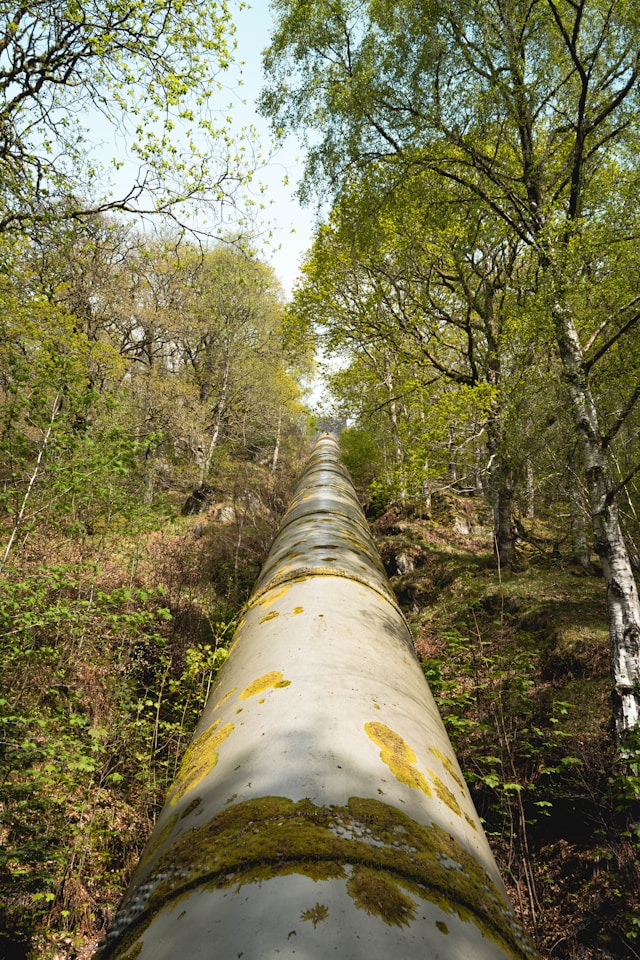
Sydney Water advises against planting within 6 metres of a wastewater pipe, and publishes a list of species to avoid: figs, plane trees, jacaranda, camphor laurel, brush box, liquidambar, paperbarks, bottlebrush, gums, poplars, willows, crepe myrtle and lilly pilly. (Sydney Water, Wastewater blockages)
The City of Sydney publishes every council-managed tree in its area, which covers Glebe, Forest Lodge, Camperdown and the city side of Newtown and St Peters. Matching species to that list: 1,217 of Glebe's 2,699 street trees (45%) are on it, led by crepe myrtle (345), water gum (273) and tuckeroo (182). In Forest Lodge it is 276 of 665 (42%), with crepe myrtle (75), water gum (50) and Sydney red gum (37) the most common. Camperdown is 61%, mostly gums, brush box and jacaranda. (City of Sydney Trees dataset)
This is not an argument against the trees. Street trees are why the suburbs look the way they do and why the canopy numbers above are high. It is an argument for knowing what is under the footpath: a crepe myrtle outside a 1900 terrace on a 600 mm-jointed earthenware line is a maintenance item, not a surprise.
Inner West Council manages about 78,000 public trees in the other 16 suburbs but does not publish its inventory as open data, so the same calculation cannot yet be made for Balmain, Leichhardt, Marrickville or Haberfield. A GIPA (freedom of information) request would unlock it, and we intend to make one.
The short answer is usually the owner. Sydney Water's rule: "You are responsible for wastewater pipes from your property up to where they connect to the wastewater pipes that form our network." Sydney Water owns the junction, but the owner is responsible for clearing tree roots that enter it at the point of connection, and for damage to the junction collar caused by roots. Sydney Water takes over only if its junction failed or the connection is deeper than 2.5 metres. (Sydney Water, Wastewater blockages, Responsibility for repairs)
Two things in the owner's favour. If a licensed plumber finds the blockage is in Sydney Water's pipes, the owner can claim reasonable out-of-pocket costs, provided the plumber logged a job number on 13 20 90 first. And if a private sewer has collapsed under a public road or footpath, Sydney Water's Collapsed Private Services in Public Land program may repair it free for residential customers, on CCTV evidence that it cannot be relined. (Collapsed private sewer program guide)
In strata it is the question that starts most disputes. NSW Fair Trading's division: the lot owner is responsible for plumbing in internal walls and fixtures; the owners corporation for plumbing in boundary walls and under the floor, and for any pipe that serves more than one lot. A blocked sewer line shared by two terraces or the units in a 1930s block is almost always common property, and emergency repairs to burst or blocked sewer pipes are exempt from the two-quote rule for works over $30,000. (NSW Government, Strata repairs and maintenance)
A tenant's position is simpler: report it in writing to the agent, with the symptoms, and the landlord carries the cost unless the tenant caused the blockage (wipes, grease, foreign objects). Which is why what you say in that first message matters.
Signs the problem is in your private line rather than Sydney Water's main: neighbours are unaffected, the drainage is not shared, there is no flooding in the street, and the overflow happens only when you use water. Signs it is shared or on the main: more than one property backing up at once, or an overflow at the street boundary with nothing running inside.
One slow basin is a local blockage. A toilet that gurgles when the shower drains, or water backing up at the lowest fixture in the house, is the main line. Sewage at the overflow relief gully outside (the grated drain near the back door) means the line to the street is blocked and the house is about to be affected. Work out which you have, then describe it. A plumber who knows it is the main line brings the right gear the first time.
A jet blast clears roots for a season; the roots grow back through the same joint. If the camera shows roots at one or two joints, cutting and relining those sections is cheaper over five years than clearing every spring. If the camera shows a collapsed section under the footpath, that is the moment to ask about Sydney Water's collapsed-sewer program before paying for an excavation.
proactive root cutting costs about a third of reactive clearing and keeps roots out for one to two years. (IPART audit 2007-08)
Ask the strata manager for the sewer diagram and confirm which lines are shared. Most Inner West blocks built before 1960 have at least one.
Sydney Water says wet wipes contribute to 75% of its blockages, because roots catch them. In a root-prone line they turn a trickle into a stoppage. (Sydney Water)

Four questions, no sign-up. It tells you the three most likely causes ranked, how urgent it is, and whether the problem is more likely your pipe, a shared one, or Sydney Water's. You can send the result to your plumber, agent or strata manager so the request arrives with the symptoms already described.
Check your drainThe suburb index is modelled exposure, not a count of blockages. Sydney Water does not publish chokes by suburb, pipe age or pipe material. The index combines three public measures for each of the 22 ABS 2021 suburbs in the Inner West:
Each measure is scaled 0-1 across the 22 suburbs, weighted and summed to a 0-100 index. The weights are a judgement, not a calibration against blockage records.
Known limits:
Blockage, cause and benchmark figures are Sydney Water's and the Bureau of Meteorology's as cited. Historical dates are from the NSW State Heritage Register and Sydney Water's published timeline.
Data as at 22 October 2026. The full suburb table is available on request.
1300 734 677