




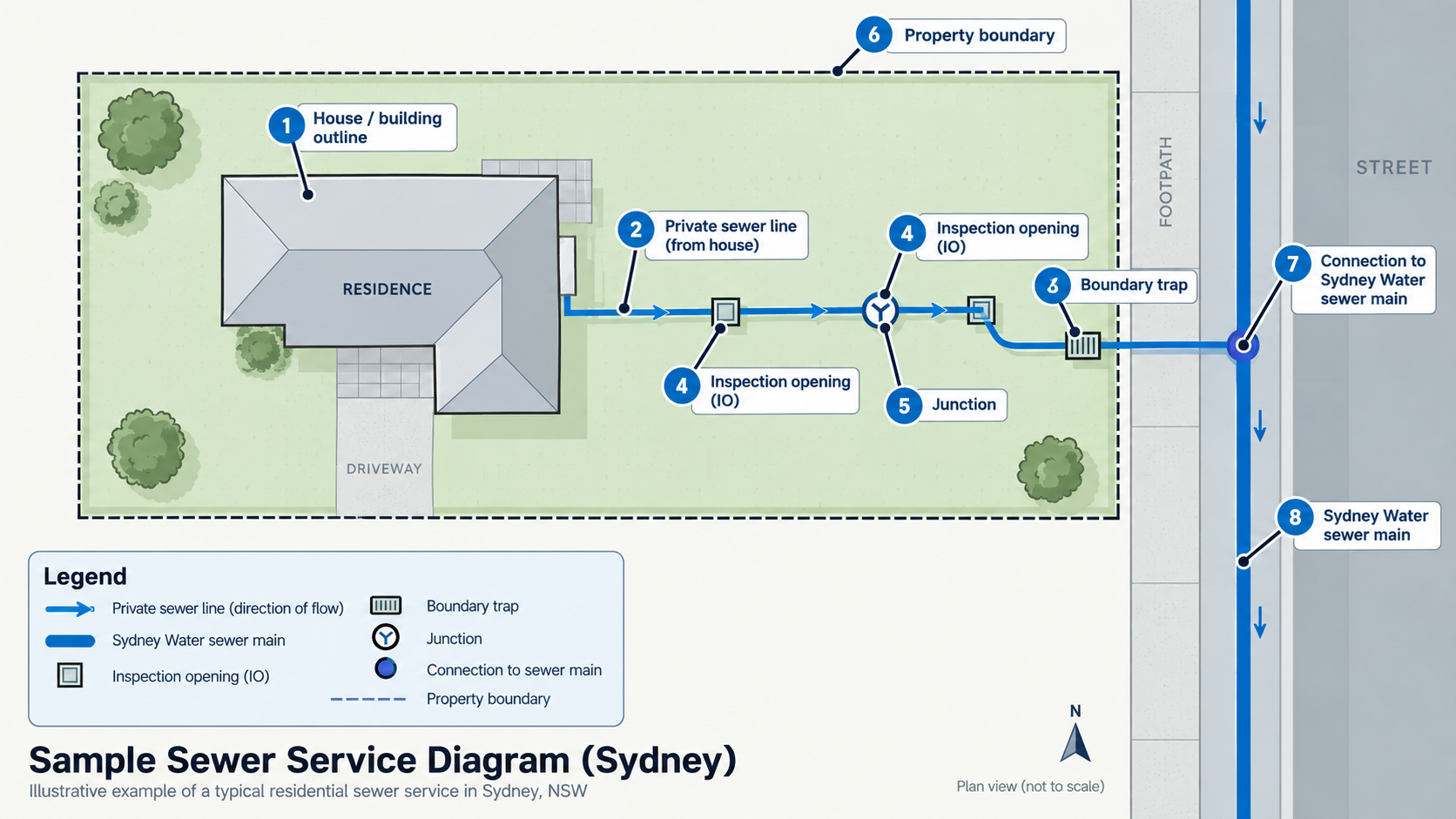
A Sewer Service Diagram (SSD) shows the private wastewater pipes on your property in Sydney, its features, connections, and how the sewer connects to the wider wastewater system.
Where to get it: Through Sydney Water Tap in, or in your conveyancing documents.
Cost: The SSD guide from the NSW government is free, while Sewer Service Diagram for a property can be ordered through Sydney Water Tap and is paid.
What a sewer service diagram is — and isn’t

A sewer service diagram, sometimes called a sewer diagram or property sewerage diagram, is a plan showing the private wastewater plumbing associated with a property. Sydney Water says these diagrams show the building and the property's private sewer pipes, including where those pipes connect to its wastewater system.
That distinction matters. The diagram is primarily about the private pipes rather than every Sydney Water asset in the street.
That makes it useful before renovation, excavation, drainage repairs or a property sale. But a diagram is not a survey of everything underground. You need to understand what it records, what it leaves out and when an on-site inspection is needed.
Your sewer diagram also shouldn't be treated as a stormwater pipes map. Stormwater infrastructure can involve separate council or Sydney Water assets, depending on the site. If your project involves both wastewater and stormwater, check the relevant infrastructure plans rather than assuming one diagram covers everything.
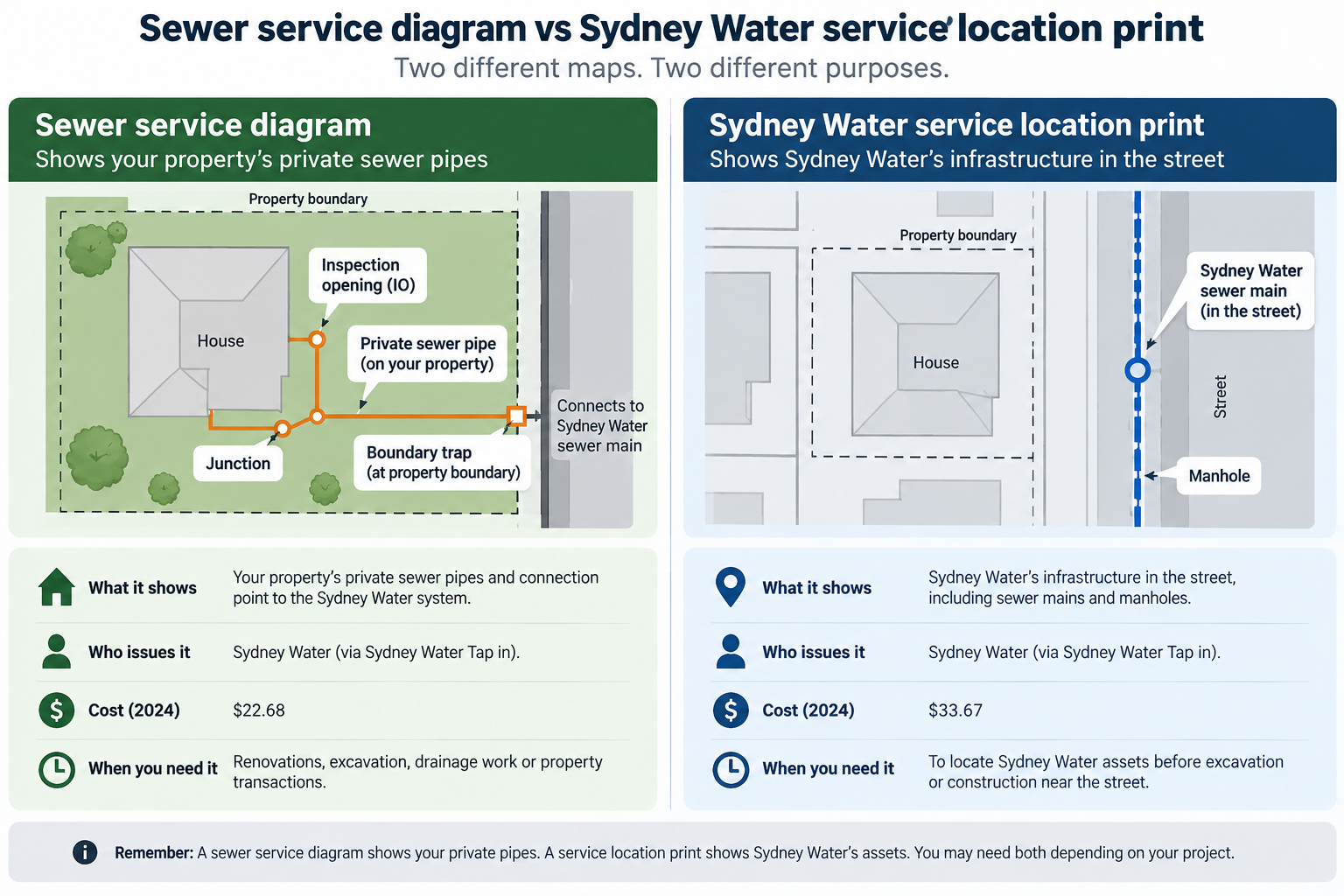
The practical distinction is simple: a sewer service diagram helps you understand your property's private sewer arrangement; a service location print helps locate Sydney Water infrastructure.
How to get yours?
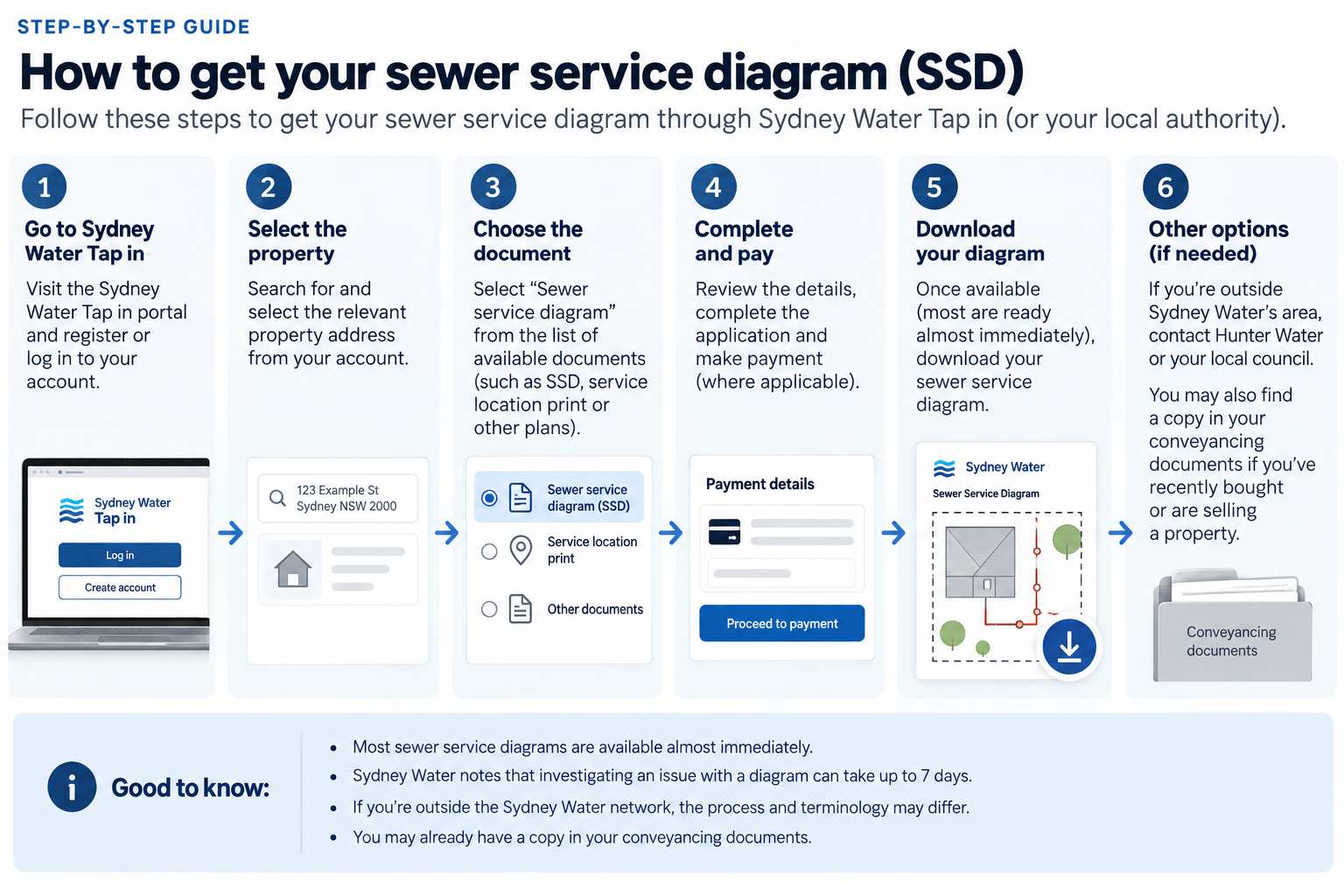
Sydney Water Tap in: the direct route
For properties within Sydney Water's service area, Sydney Water Tap in is the online starting point for ordering diagrams and prints. Sydney Water says users can request wastewater service diagrams and service location prints through the portal.
The process is straightforward:
- Register or log in to Sydney Water Tap in.
- Select the relevant property.
- Choose the sewer service diagram or other document required.
- Complete the application and payment where applicable.
- Download the resulting document when it becomes available.
Most sewer service diagrams are available almost immediately, although Sydney Water notes that investigating an issue with a diagram can take up to seven days.
From your conveyancer or contract of sale
If you've recently bought or are preparing to sell a property, check your conveyancing documents before ordering another copy. The diagram is required for property transactions under the Conveyancing Regulation 2022.
Selling agents and conveyancers commonly use sewer diagrams to understand the private sewer arrangement and identify information relevant to the sale. They can also help identify whether there are private pipes crossing the property or whether plumbing work has been recorded.
For a new property purchase, this can be particularly useful before you plan a renovation, pool or extension. A diagram found in the sale documents can give you an early indication of where wastewater infrastructure sits, but it should not replace site verification for construction.
Outside Sydney Water’s area
Not every part of NSW is covered by Sydney Water. Depending on the location, the relevant authority may be Hunter Water or a regional water authority or council.
The important point for the NSW-wide search is to identify who manages the local wastewater infrastructure before ordering a service diagram. The terminology and application process can differ outside the Sydney Water network.
How to read the diagram?
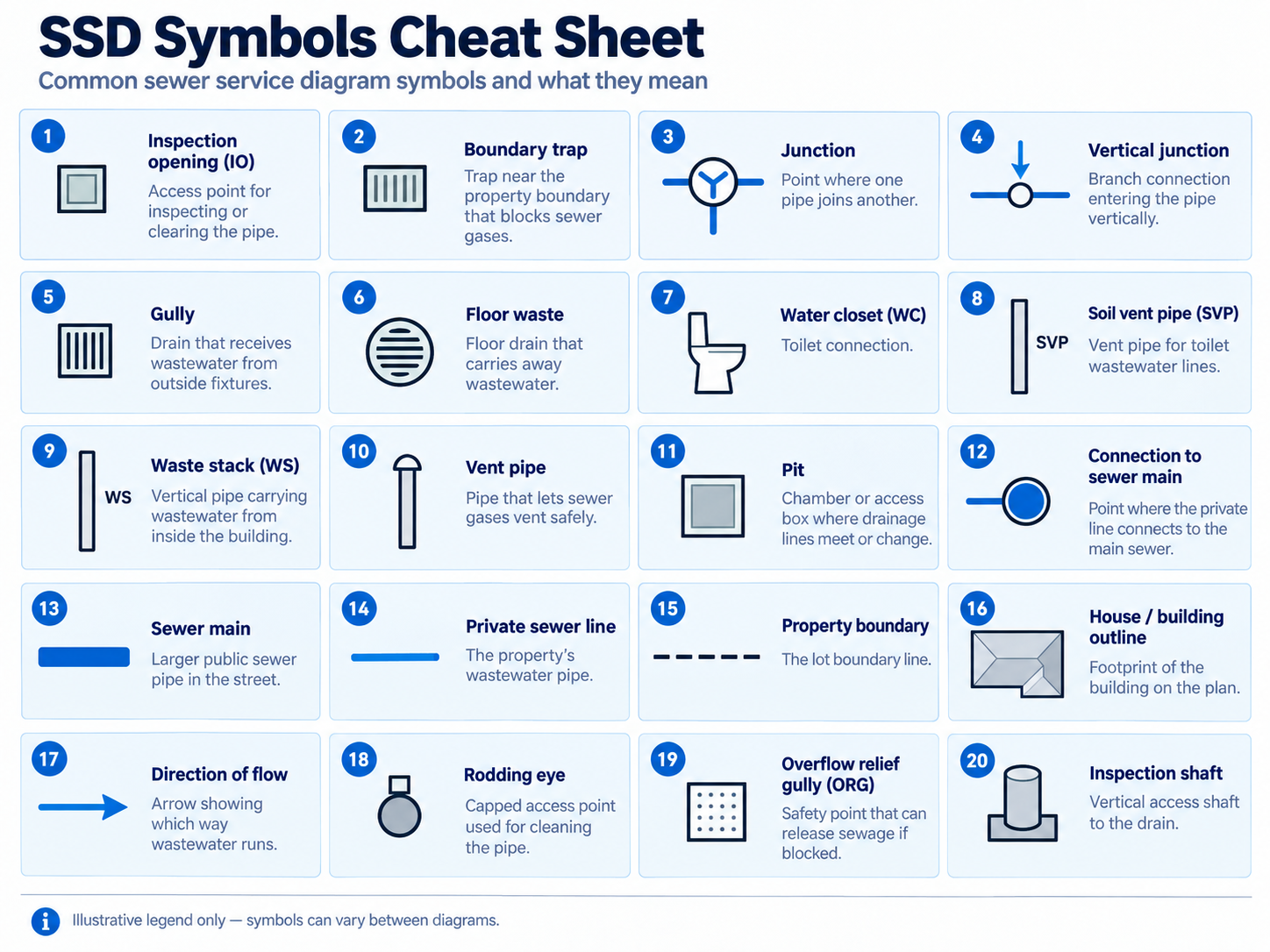
- Start by identifying the building outline and the line representing the property's wastewater pipes. Follow that line rather than assuming the shortest route from the house to the street is the actual pipe path.
- Look for the connection point and any inspection openings, junctions or other marked features. Sydney Water's own guide explains symbols used for features such as vertical junctions, vertical pipes, waste stacks and water closets. It also notes that sewer service diagrams generally show ground-level wastewater plumbing, with abbreviations used where additional storeys are involved.
- The boundary is another important reference. You want to understand whether a section of private plumbing runs within the lot, along a boundary or across another part of the land.
- Pipe direction and connection details can also help a plumber work out how the system is arranged. But don't assume every underground feature is shown with survey-level accuracy.
What does the diagram tell you before drainage work?
Before quoting drainage work, a plumber can use the diagram to understand the likely route of the private sewer and where access may be available.
That matters for jobs such as pipe relining, excavation and blockage investigation. Knowing where the pipes are expected to run can help determine where a CCTV camera inspection should start and where access equipment may be required.
Pipe diameter and material are often indicated on sewer service diagrams. It can also provide useful context when tree roots are suspected. If a recurring blockage appears close to a large tree, the diagram can help establish the relationship between the tree and the sewer route before further investigation. For suspected root intrusion, see our guide to tree root removal in Sydney.
The same information becomes important during renovation planning. A home extension, dual occupancy, swimming pool or other construction project may require more than simply knowing where the private pipe appears on paper.
When the diagram is wrong?
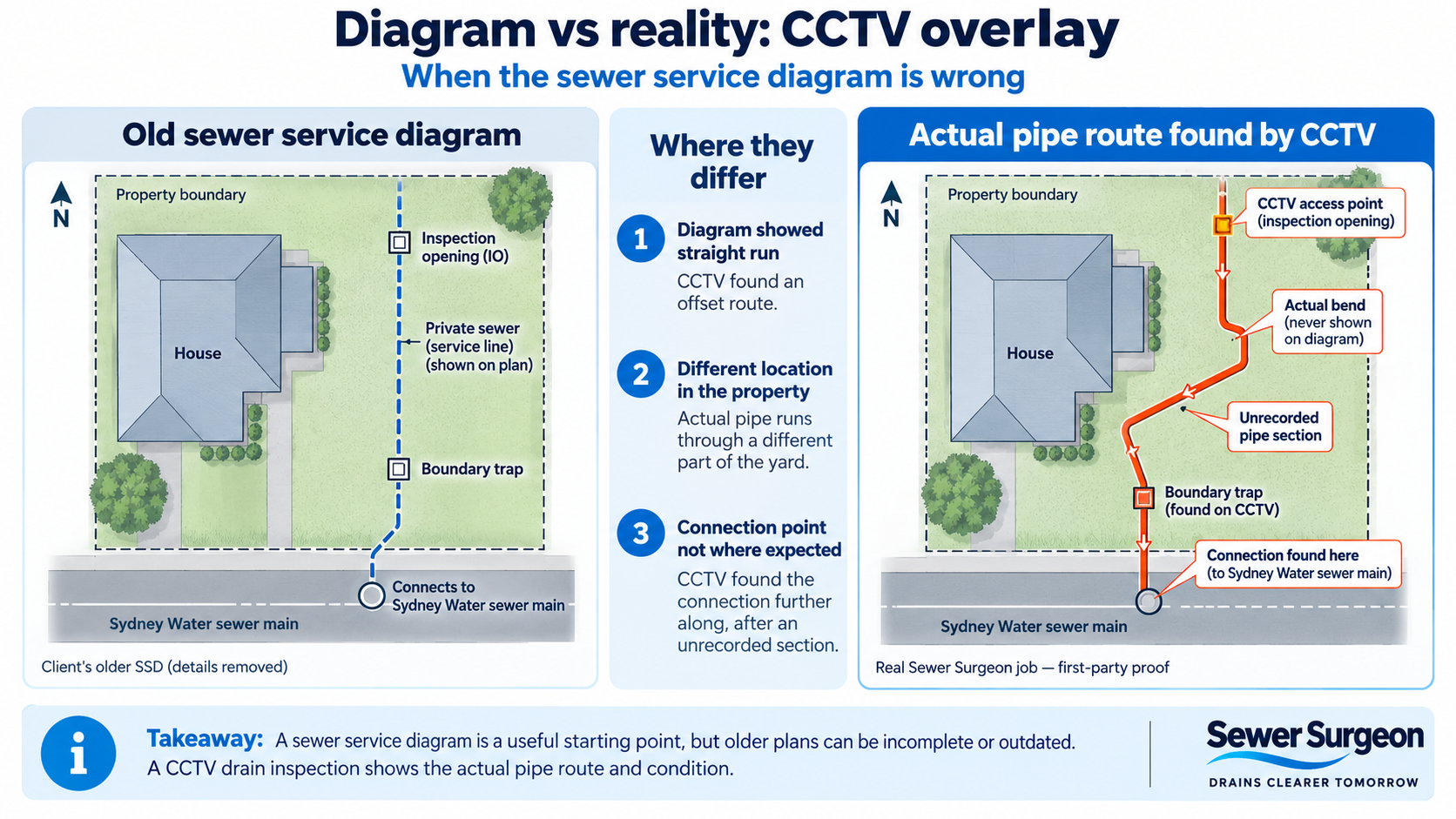
A sewer service diagram can be old or outdated. A house may have had an extension, alteration or undocumented private plumbing work since the plan was prepared. Sydney Water itself advises that if there is a plumbing system that is not shown on the diagram, it may not have been inspected or recorded.
The NSW Fair Trading lodgement rule states that after completing the drainage work, it is important for the plumbers and traders to submit a copy of the updated Sewer Surgeon Diagram to the the relevant plumbing regulator through the MyInspections Gateway, especially for the inspection-related work in Sydney and other listed metropolitan areas. Another copy must be handed over to the builder or the owner of the respective property.
There is also an important limitation in Sydney Water's current terms: sewer service diagrams are prepared from information supplied by third parties, and Sydney Water does not guarantee that they are accurate, complete, current or fit for a particular purpose. So treat the document as a starting map, not proof of exactly what is underground.
For a blockage, suspected root intrusion or proposed repair, a CCTV drain inspection can show the actual condition and route of the pipe.
Easements, encasement and building over the sewer
Sewer and drainage easements
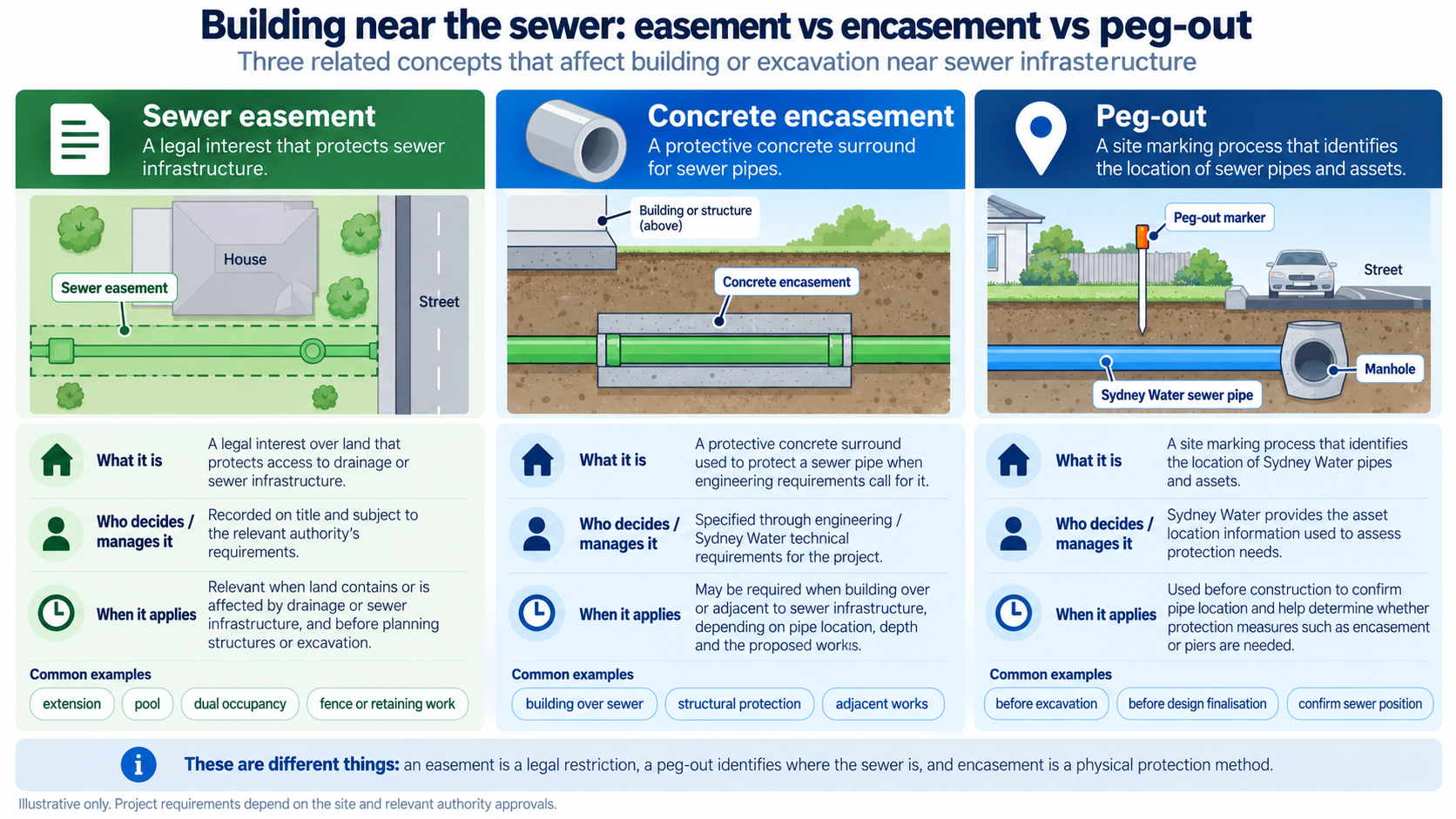
A drainage easement or sewer easement is a legal interest recorded against land that can give an authority or another party rights relating to drainage infrastructure.
An easement should not be treated as spare building space. Restrictions can apply to structures, excavation and access, depending on the terms of the easement and the infrastructure involved. Check the title and relevant authority requirements before designing around one.
Building over or near a sewer
If a building or structure is close to Sydney Water infrastructure, additional approval may be required. Sydney Water provides a building-over-sewer process and says building plans need its approval where its pipes may be affected.
This is where pipe relining Sydney or sewer protection measures can become relevant. Sydney Water's technical guidance includes requirements for situations involving building over or adjacent to sewer assets, including locating the pipe, determining its depth and considering rehabilitation or concrete encasement where applicable.
Sewer encasement and peg-outs
Sewer encasement generally refers to protecting a sewer pipe with concrete where the engineering requirements call for it.
A sewer peg-out is different. Sydney Water explains that a peg-out identifies the location of its pipes and assets and provides information used to determine whether additional protection, such as concrete encasement or concrete piers, is required.
These are construction-stage matters. It is not something a homeowner should infer from the sewer diagram alone. A builder, engineer or relevant water servicing professional should establish what the project requires.
Strata buildings: diagrams, stacks and common property
In a strata building, the diagram can help show where private lot plumbing sits, but it cannot by itself settle every ownership or maintenance question.
A vertical wastewater stack, branch line or pipe serving multiple lots may have different implications from a pipe serving only one residence. The plan also may not provide enough information to determine where common property responsibility begins and ends.
For that reason, strata buildings benefit from keeping current plumbing records and CCTV mapping alongside older diagrams. For larger strata drainage issues, see our strata plumber Sydney service.
If the question is who pays for a repair, check the strata plan, by-laws and relevant maintenance responsibilities rather than relying solely on the sewer diagram. For property transactions, a specialist real estate plumber Sydney can also help identify drainage concerns before settlement.
Frequently asked questions
How do I find my sewer diagram in NSW?
If the property is within Sydney Water's service area, use Sydney Water Tap in to order a sewer service diagram. You may also find one in your conveyancing documents. Outside the Sydney Water network, check the relevant local water authority or council.
Is a sewer service diagram free?
Not necessarily. The SSD guide from the NSW government with symbols, templates, and detailed guidance is free, while Sydney Water Tap in charges for Sewer Service Diagram for a specific property.
Does a sewer diagram show stormwater?
A sewer service diagram focuses on private wastewater plumbing. If you need to locate Sydney Water's stormwater, water or wastewater assets, a service location print is the more appropriate document.
Can I build over the sewer shown on my diagram?
Not simply because the diagram shows it on your property. Building over or near Sydney Water infrastructure can require approval and specific engineering measures. The actual requirements depend on the project and the asset involved.